

Risk-Reducing Mastectomy Questioned for BRCA Mutation Carriers with Prior Ovarian Cancer
Study finds little survival benefit and high costs from the preventive procedure
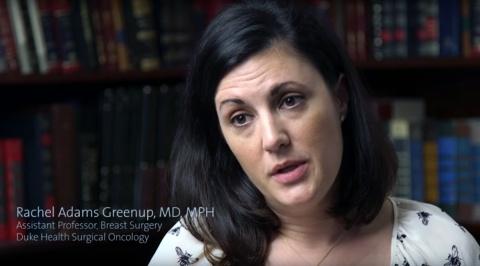
Mutations in the BRCA gene correspond to a higher lifetime risk of developing breast and ovarian cancers, and many women who carry these mutations consider undergoing mastectomy or removal of the ovaries and fallopian tubes as preventive measures.

Duke Researchers Find Alcohol Abuse Drug Disrupts Tumor Emboli Formation in Inflammatory Breast Cancer
Study Provides New Insights Into 3D Imaging and Targeting Tumor Emboli in Patients with Inflammatory Breast Cancer
Duke researchers have found that a drug used for alcohol abuse reduces the formation of tumor emboli in inflammatory breast cancer (IBC), one of the most lethal types of breast cancer. Current barriers to the successful treatment of IBC include the presence and frequent infiltration of tumor cell clusters, termed tumor emboli, within the breast parenchyma and lymphatics.

Dr. Rachel Greenup Receives Health Policy Scholarship
Congratulations to Rachel Greenup, MD, MPH, Division of Advanced Oncologic and Gastrointestinal Surgery, for being selected as a recipient of the Health Policy Scholarship provided by the American College of Surgeons and the American Society of Breast Surgeons.

Duke Surgery Advanced Practice Providers Recognized by PDC
Congratulations to the following Advanced Practice Providers on your most recent accomplishments!
Reducing Radiation Could Safely Cut Breast Cancer Treatment Costs
A shorter regimen is scientifically sound, but most women still get the longer therapy
More than half of older women with early stage breast cancer received more radiation therapy than what might be medically necessary, adding additional treatment and health care costs, according to a study led by Duke Cancer Institute researchers.

Dr. Lisa Tolnitch Receives Humanism in Medicine Award for Exceptional Work in Breast Cancer Treatment
Each year, the American Society of Breast Surgeons and the Arnold P. Gold Foundation present the Humanism in Medicine Award to one practicing physician who provides effective, compassionate, and empathetic care to breast cancer patients. Duke Surgery would like to congratulate Lisa Tolnitch, MD, Assistant Professor, Division of Advanced Oncologic and Gastrointestinal Surgery, for being the 2017 recipient of the Humanism in Medicine Award. Dr. Tolnitch is recognized for her continued efforts to provide breast cancer treatments to underinsured and uninsured patients in North Carolina.

Gayathri Devi, PhD, Presents at Inflammatory Breast Cancer Conference
Gayathri Devi, PhD, Associate Professor in Surgery, Division of Surgical Sciences, was invited to the Morgan Welch Inflammatory Breast Cancer Research Program 10th Anniversary Conference as a guest speaker and chair of the general session.

High-Volume Hospitals Have the Greatest Success in the Fight Against Breast Cancer
Breast cancer is the most prevalent cancer diagnosis for women in the United States, with over a quarter million new cases reported in 2016. While incidence rates have decreased in the U.S. since 2000, the treatment of breast cancer has become more varied and complex in recent years, with systemic therapy, surgery, and radiation offering diverse approaches to treatment. The success of these treatments varies from patient to patient, but a new study led by Dr. Rachel A.