
Overview
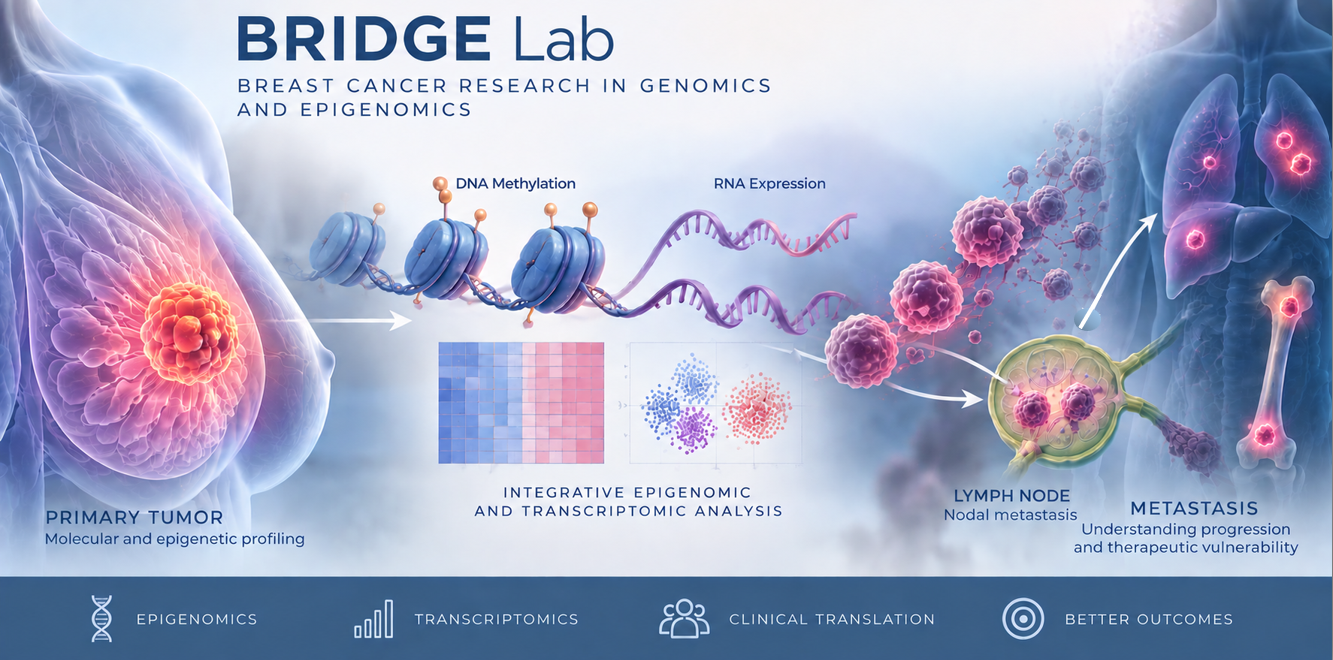
The Breast Cancer Research in Genomics and Epigenomics (BRIDGE) Lab, led by Maggie DiNome, MD, in the Division of Surgical Oncology's Section of Breast Surgery, investigates the epigenetic and genomic mechanisms underlying breast cancer progression, metastasis, and treatment response. Our research aims to translate molecular discoveries into clinically actionable tools for risk stratification and personalized care.
A central focus of the lab is understanding how DNA methylation and other epigenetic alterations shape tumor behavior—including nodal involvement, metastatic spread, and immune evasion—across breast cancer subtypes, from ER+/HER2– to triple-negative disease. By integrating epigenomic and transcriptomic data from primary tumors, the lab seeks to identify biomarkers that can predict which patients face higher risk of nodal or distant metastasis, and to uncover the biological programs that drive that risk.
Current areas of focus include:
- Epigenetic drivers of nodal burden and metastatic risk in ER+/HER2– breast cancer, characterizing tumor-intrinsic programs associated with lymph node involvement
- DNA methylation reprogramming and lung metastasis in triple-negative breast cancer (TNBC), identifying regulatory elements that promote metastatic spread
- Immune-evasive epigenetic phenotypes in HER2-low and triple-negative breast cancer, with implications for immunotherapy response
- Development and validation of epigenetic classifiers for pathologic nodal stage, using multi-center breast cancer cohorts to build clinically applicable tools
The lab works in close collaboration with translational and computational cancer researchers, combining clinical breast surgery expertise with genome-wide methylation profiling and transcriptomic analysis. This multi-center, collaborative approach allows the BRIDGE Lab to validate findings across diverse patient cohorts and move discoveries closer to clinical application.
Our team fosters a collaborative environment for postdoctoral fellows and research scientists to pursue impactful, patient-centered science, with the shared goal of improving outcomes for patients with breast cancer through a deeper understanding of tumor epigenetics.
Lab Members
Current Lab Members
Dr. DiNome is a breast surgical oncologist and translational researcher whose research focuses on the molecular mechanisms underlying breast cancer progression, metastasis, and treatment response. She leads the BRIDGE Lab's efforts to integrate clinical investigation with epigenomic, transcriptomic, and functional approaches to identify tumor biology associated with metastatic risk and therapeutic response.

Dr. Ensenyat-Méndez is a computational scientist studying the genomic and epigenomic mechanisms underlying breast cancer progression and treatment response. His work integrates DNA methylation, transcriptomic, and clinical data to identify molecular programs associated with nodal and distant metastasis and tumor immune evasion.
Watch: Miguel Ensenyat Mendez, Full Interview (MD Newsline)
Miquel Ensenyat Méndez - clinical researcher at Duke University discusses the study he presented at San Antonio Breast Cancer Symposium: Generation and validation of primary breast cancer epigenetic classifiers of pathologic nodal stage in a multi-center breast cancer cohort

Dr. Alorda-Clara focuses on translating epigenetic discoveries into clinically applicable molecular assays. Her current work centers on developing a PCR-based assay for the BRIDGE Lab’s epigenetic signature of nodal burden in ER+/HER2− breast cancer, with the goal of enabling its validation and potential application in clinical specimens.

Sofia is a Duke University undergraduate researcher who supports multiple translational research projects in the BRIDGE Lab. Her work includes DNA isolation and processing of clinical tumor specimens, database management, and other laboratory and research activities supporting ongoing studies.

Dr. Thomas studies alternative RNA splicing as a therapeutic vulnerability in triple-negative breast cancer. His research focuses on ultra-conserved poison exons and the development of splicing-directed strategies to restore poison-exon inclusion and selectively target tumor cells, integrating computational discovery with experimental therapeutic development.
Visiting Research Scholars

Dr. Ahn is a breast surgeon from Seoul, South Korea, who spent one year in the BRIDGE Lab as a visiting research scholar. During her time at Duke, she contributed to studies examining the molecular and epigenetic determinants of breast cancer progression and treatment response, including the lab’s work on nodal burden in ER+/HER2− breast cancer and immune evasion in HER2-low triple-negative breast cancer. Her work contributed to two BRIDGE Lab publications, including a study of HER2-associated immune evasion in triple-negative breast cancer for which she was a co-first author.

Dr. Llinàs-Arias joined the BRIDGE Lab as a post-doctoral visiting research scholar, contributing to studies of epigenetic mechanisms underlying breast cancer metastasis. His work focused on DNA methylation reprogramming of gene regulatory elements associated with lung metastasis in triple-negative breast cancer and contributed to a 2026 publication in Communications Biology.

Sandra joined the BRIDGE Lab for six months as a visiting research scholar from Spain, where she studied epigenetic and transcriptomic alterations associated with nodal burden and metastatic risk in ER+/HER2− breast cancer. Her work resulted in a 2026 first-author publication in International Journal of Molecular Sciences. She is currently completing her PhD in Spain.
Longstanding Collaboration
Diego M. Marzese, PhD, Collaborating Investigator and Former Lab Member
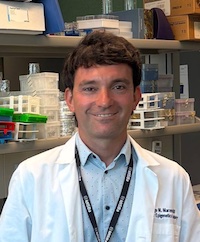
Dr. Diego Marzese has been a longstanding scientific collaborator of Dr. Maggie DiNome, with their partnership spanning more than 15 years and multiple institutions. Their collaborative research focuses on the epigenetic mechanisms underlying breast cancer progression, metastasis, and treatment response. Dr. Marzese joined Duke as a Research Scientist and played a key role in establishing the BRIDGE Lab, helping to build its epigenomics and computational research programs.
Dr. Marzese is now an independent Principal Investigator leading the Cancer Epigenetics Laboratory at the Health Research Institute of the Balearic Islands (IdISBa) in Palma, Spain, while maintaining an adjunct faculty appointment at Duke and an active collaboration with the BRIDGE Lab. This enduring partnership links complementary research teams at Duke and IdISBa and continues to support joint studies in breast cancer epigenetics, tumor progression, metastasis, and immune evasion. Recent work demonstrates the ongoing integration of the two groups, with Drs. Marzese and DiNome jointly contributing to studies of HER2-associated immune evasion, nodal burden, and metastatic progression in breast cancer.
Selected Contributions
The BRIDGE Lab has contributed to advancing the understanding of breast cancer epigenetics through recent work including:
- Tumor-intrinsic epigenetic programs associated with nodal burden and metastatic risk in ER+/HER2− breast cancer — characterizing the epigenetic alterations that drive lymph node involvement and metastatic potential in this common breast cancer subtype.
- DNA methylation reprogramming of gene regulatory elements associated with lung metastasis in triple-negative breast cancer — identifying methylation changes at regulatory elements that promote metastatic spread to the lung in TNBC.
- Epigenetic determinants of an immune-evasive phenotype in HER2-low triple-negative breast cancer — uncovering epigenetic mechanisms by which HER2-low TNBC tumors evade immune detection, with implications for immunotherapy strategies.
- Generation and validation of primary breast cancer epigenetic classifiers of pathologic nodal stage in a multi-center breast cancer cohort — developing clinically applicable tools to predict nodal stage using epigenetic markers.
This work reflects ongoing collaboration with translational cancer research groups and multi-institutional cohorts, reinforcing the lab's commitment to producing findings that are both scientifically rigorous and clinically translatable.
Funded Projects and Publications
A full list of Dr. DiNome's funded projects, publications, and scholarly output is available on her Scholars@Duke profile.
Contact
Interested researchers and colleagues should contact:
James Thomas, PhD, Research Scientist
Office: 919-660-4383
Lab: 919-660-4382
james.d.thomas@duke.edu